Why Black People Have Been Losing the Game of Monopoly in Life
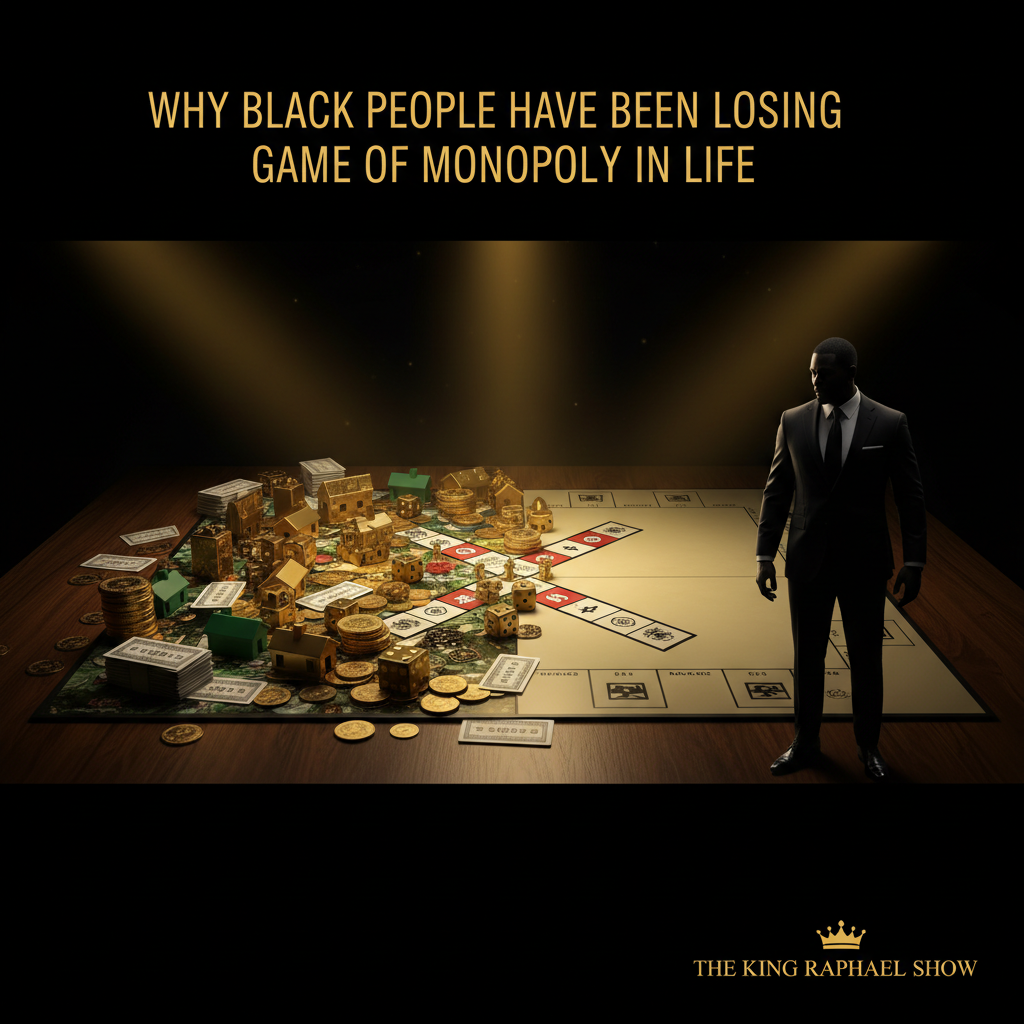
The history of Black people in America is a lot like starting a game of Monopoly with no money, no properties, and a set of rules stacked against you. Here's how to change the game.
The history of Black people in America is a lot like starting a game of Monopoly with no money, no properties, and a set of rules stacked against you. After slavery ended, we were promised 40 acres and a mule—a chance to start the game with some resources—but that promise was never fulfilled (Williams, E., Capitalism and Slavery). Instead, we were released with nothing. No money, no land, and no opportunity to fairly compete in the game of life.
Imagine sitting down at the Monopoly board where one group of players already owns properties and collects rent while another group starts with empty hands. This disparity is exactly what happened in real life. For centuries, systemic barriers like Jim Crow laws, redlining (The Color of Law, Rothstein), the Homestead Act, and even violent groups like the Ku Klux Klan actively worked to block Black progress. These obstacles prevented us from acquiring the assets that are essential to winning—like land, homes, businesses, and generational wealth.
Let's look at the numbers. Today, the average white household holds nearly ten times the wealth of the average Black household (Federal Reserve Survey of Consumer Finances, 2019). A white child is often born into a family with resources: a home, savings, and sometimes even an inheritance. Meanwhile, many Black families are still playing catch-up, starting with debt instead of wealth (Pew Research Center, 2021). This isn't just history—it's the reality of how the game is still being played.
In Monopoly, when you're blocked from buying properties, you're left with no way to generate income. You're stuck passing GO, collecting a small paycheck, and trying to stay afloat. In real life, the same thing happens. Without assets, Black families are often left to rely on wages alone, which are taxed and spent on basic survival. Meanwhile, wealthier families build their income through investments, which grow over time and are passed down to future generations (The Asset Gap, Oliver & Shapiro, 1995).
Playing Without a Fair Shot
When the rules of the game are rigged, desperation sets in. In Monopoly, a player with no properties might try to bend the rules or trade under the table just to stay in the game. In real life, this desperation can lead to crime, not because of a lack of character, but because of a lack of opportunity. When you're locked out of the system, you're forced to play "off the board," and the consequences are devastating.
The prison system is filled with people who were never given a fair shot to win the game. Statistically, Black Americans are incarcerated at far higher rates than white Americans. Many of these individuals were simply trying to survive in a system that offered them no legitimate way to succeed. Think of the Monopoly rule where a player who lands in jail loses valuable turns. In life, those lost turns represent lost years of productivity, income, and potential.
How Far We've Come—And How Far We Have to Go
Despite these systemic challenges, Black people have made incredible strides. From building thriving businesses to creating art and culture that influences the entire world, we've shown resilience and creativity in the face of adversity. Statistically, more Black Americans are now college-educated, own homes, and are building wealth than ever before. But the disparities remain, and the rules of the game are still not equal.
This is why it's so important to focus on ownership. Every property, business, and investment is a step toward changing the game. It's about breaking the cycle and creating opportunities for the next generation. We can't rewrite history, but we can rewrite the future.
The Path Forward
If you're Black in America, you're not just playing Monopoly—you're playing Monopoly on hard mode. But here's the good news: The game isn't over. By understanding the rules, building assets, and investing in ourselves and our communities, we can change the narrative. It starts with financial literacy, entrepreneurship, and collective action. It starts with refusing to let the past define our future.
Remember, Monopoly is just a game. But life is real, and the stakes are higher. It's time to roll the dice, make bold moves, and claim our place on the board. The road won't be easy, but with strategy, resilience, and unity, we can win the Monopoly of life.
Leave a Comment
Your email address will not be published. Required fields are marked *
Follow me on Instagram
@thekingraphaelshow